
Blog
"I Don't Wanna Do My Homework": How to Get Started Anyway
Feeling "i don't wanna do my homework"? Learn to diagnose the real block, use quick focus tricks, and know when expert help can finish it fast.

"I Don't Wanna Do My Homework": How to Get Started Anyway
You're staring at the screen, the assignment is open, and every part of you wants to do literally anything else. If you typed "i don't wanna do my homework" into Google hoping for a fix, you're not lazy, you're stuck, and that's a different problem with a different solution.
The reluctance usually isn't about the subject itself. It's about overwhelm, unclear instructions, or a task that feels bigger than the time you have left before it's due. Once you break the assignment into smaller moves and remove the decision fatigue around "where do I even start," the resistance drops fast. That's what actually gets you from avoidance to a finished page.
This guide walks through specific, tested ways to get moving even when motivation is nowhere in sight, from two-minute starting tricks to handling the subjects that trip you up most, like math sets or long essays. And if you get through these steps and still hit a wall on a specific problem or deadline, that's exactly the gap tutors and step-by-step explanations are built to close, not to do the work for you, but to get you unstuck enough to finish it yourself.
Why homework resistance feels so overwhelming
The feeling of "I don't want to do my homework" isn't a character flaw, it's your brain doing exactly what it's designed to do: avoid pain. Neuroscience research on task aversion shows that when a task feels ambiguous, effortful, or emotionally loaded, your amygdala treats it like a genuine threat, triggering the same avoidance response you'd have toward something physically risky. That's why a ten-page paper can make you suddenly need to clean your entire room. The dread isn't really about the assignment; it's about your nervous system trying to protect you from discomfort it hasn't learned to tolerate yet.
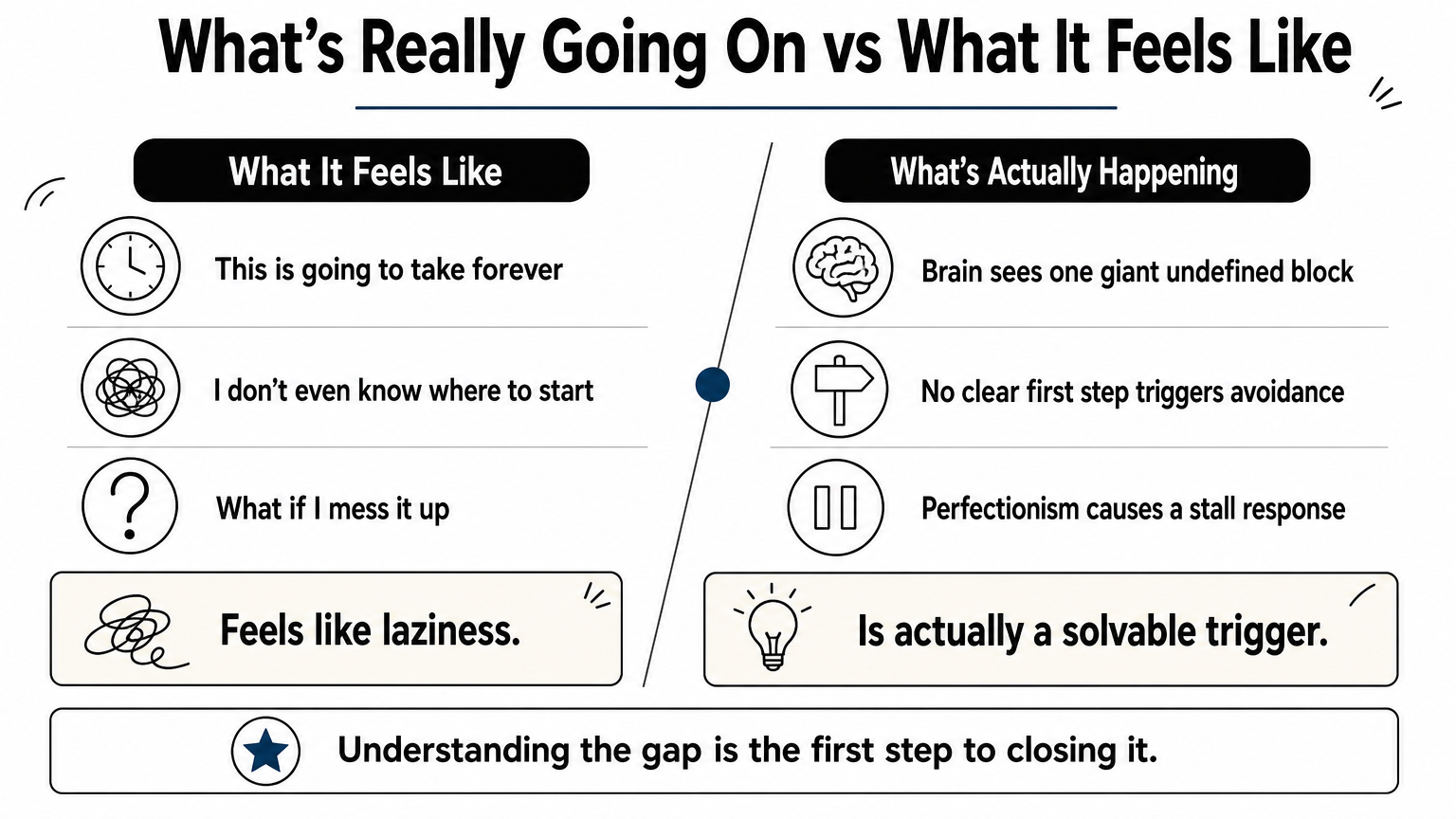
Your brain treats big tasks like threats
Opening a syllabus and seeing "Research Paper, 3000 words, due Friday" gives your brain nothing concrete to grab onto. There's no clear first move, so it defaults to avoidance as the safest option. Compare that to something like "take out the trash," which your brain processes instantly because the steps are obvious. Homework rarely comes pre-chunked like that, so the resistance you feel is really your mind reacting to a task that looks like one giant, undefined blob of effort.
The dread you feel isn't about the subject, it's your brain reacting to a task with no clear starting point.
Decision fatigue makes starting harder than finishing
By the time you sit down to study, you've already made hundreds of small decisions that day, what to eat, what to wear, whether to answer that text. Each one drains a limited pool of mental energy, a concept psychologists call decision fatigue. Starting homework requires another decision (where do I begin, which problem first, do I need my notes), and if your tank is already low, your brain picks the path of least resistance: closing the laptop. This is a big reason students who say "i don't want to do my homework" aren't struggling with the material itself, they're struggling with the mental cost of figuring out where to enter it.
Perfectionism quietly raises the stakes
Sometimes the block isn't laziness at all, it's fear of doing it wrong. If you're worried about a low grade, disappointing a professor, or turning in something "not good enough," your brain may stall entirely rather than risk producing an imperfect draft. This shows up most in writing assignments and open-ended problem sets, where there's no single right answer to plug in.
| Common trigger | What it feels like | What's actually happening |
|---|---|---|
| Vague instructions | "I don't even know where to start" | Brain has no clear first step, defaults to avoidance |
| Long, open-ended task | "This is going to take forever" | Task perceived as one giant block, not smaller pieces |
| Fear of a bad grade | "What if I mess it up" | Perfectionism triggers a stall response |
| Mental exhaustion | "I just can't right now" | Decision fatigue from earlier choices in the day |
Recognizing which trigger you're dealing with matters more than pushing through with sheer willpower. A vague assignment needs clarity, not motivation. Exhaustion needs rest or restructuring, not guilt. Once you can name what's actually stalling you, the next steps in this guide will make a lot more sense, and a lot more doable.
Step 1. Pinpoint why you're actually stuck
Before you try any productivity trick, spend two minutes figuring out which flavor of stuck you're dealing with. Diagnosing the block matters because the fix for confusion looks nothing like the fix for burnout, and throwing a timer app at a comprehension problem just wastes another twenty minutes. Ask yourself one simple question: if a friend handed you this exact assignment right now, would you know what to do first? If the answer is no, you're not procrastinating, you're missing information.
Run a quick self-check
Grab the assignment sheet and answer these four questions honestly. They take less time than scrolling your phone one more round.
- Do I understand what's being asked? If you can't restate the assignment in your own words, that's your real problem, not motivation.
- Do I know the very first physical action? Opening a textbook to page 42 counts. "Start the essay" does not.
- Am I avoiding this because I'm tired, or because I'm scared it'll be bad? Exhaustion and perfectionism need different responses.
- Is the deadline actually today, or does it just feel urgent? Sometimes the panic is bigger than the real time pressure.
If you can't name your first physical step, that's the block, not your motivation.
Match the cause to the fix
Once you've named the trigger, the next move gets obvious instead of guessed at. Someone who typed "i don't wanna do my homework" because the instructions are confusing needs to email the professor or reread the rubric, not grind through more willpower. Someone who's simply exhausted needs a fifteen-minute break or an earlier bedtime, not another pep talk. And someone stalling on a paper because they're scared of writing something bad needs permission to produce an ugly first draft, not more research.
Writing down the specific reason, even in one sentence at the top of your notes, keeps you from repeating the same avoidance loop tomorrow. Take that sentence into Step 2, because it changes exactly how small you need to shrink the task to get moving again.
Step 2. Shrink the task into a 5-minute start
Once you know what's actually blocking you, the next move is to make the first step so small it feels almost pointless to skip. This is the core trick behind beating task paralysis: your brain resists "write the essay" but won't put up a fight against "open a blank document and write one sentence." The goal isn't to finish anything in five minutes, it's to break the seal so momentum can take over from there.

Pick a task so small it feels silly
Grab whatever assignment is stalling you and write down the smallest possible physical action tied to it. Not "study chapter 6," but "read the first paragraph." Not "do the problem set," but "copy problem one onto paper." This works because of a well-documented behavioral pattern: starting is what your brain fights, not continuing. Once you're two minutes in, the momentum effect usually carries you well past your original five-minute goal.
Make the first step so small your brain doesn't bother resisting it.
Use a real timer, not a vague promise
Set an actual timer for five minutes and tell yourself you can stop the second it goes off, no guilt attached. Here's a template you can copy for almost any subject:
Task: [name the assignment]
Smallest first move: [one concrete action, e.g. "read question 1"]
Timer: 5 minutes
Rule: when the timer ends, I can stop OR keep going, no penalty either way
This removes the biggest hidden cost of starting homework, which is the fear that once you begin you're locked into hours of effort. You're not. You're committing to five minutes, and that's genuinely all you owe yourself right now.
Stack it onto something you already do
If you still can't get moving, attach the five-minute start to a habit you already have, right after you make coffee, right when you sit down after dinner, right after you close your last class tab. Pairing a new behavior with an existing one is a technique behavior researchers call habit stacking, and it works because you're not relying on willpower to remember or decide, the trigger does the deciding for you. Students who say "i don't wanna do my homework" every single night usually don't have a motivation problem, they have a starting-cue problem, and this fixes exactly that.
Step 3. Set up a distraction-free workspace
Even with a five-minute start locked in, the wrong environment will pull you right back out of it. Your phone buzzing, a sibling walking through, or six open tabs of unrelated content all compete for the same limited attention you just fought to reclaim. Setting up a distraction-free workspace before you start beats trying to resist temptation while you work, because willpower is a finite resource and every notification drains it a little more.
Remove the phone, don't just silence it
Putting your phone in another room, not just face-down on the desk, changes behavior in a way "silent mode" never does. Studies on attention residue show that even an unused phone within eyesight pulls a measurable slice of your cognitive capacity, because part of your brain stays on alert for it. Try this quick setup before every homework session:
- Phone in a different room, or in a drawer you have to physically get up for
- Close every browser tab unrelated to the assignment, not just minimize them
- Turn off desktop notifications for email, Slack, or group chats
- Tell whoever you live with you're heads-down for the next 25 minutes
A phone within eyesight steals focus even when it's silent, so get it out of the room entirely.
Build a space that signals "work time"
Getting your body into a consistent physical spot, ideally not your bed, trains your brain to associate that location with focus instead of avoidance. Bed reading and homework in the same spot confuses the signal your brain relies on, which is part of why so many students say "i don't want to do my homework" while literally lying on top of the assignment they're avoiding. A desk, a kitchen table, even a specific library seat works, as long as you use it consistently.
Daylight or a bright desk lamp also matters more than people expect; dim lighting nudges your brain toward low-energy, low-focus mode. Once your environment stops fighting you, the next step is making the actual work session feel less like an endless grind, which is exactly what timed sprints are built to fix.
Step 4. Work in timed sprints with built-in rewards
Once you've broken the seal with your five-minute start, the next challenge is staying in motion without burning out halfway through. Timed sprints work because your brain handles short bursts of focused effort far better than open-ended stretches with no visible end. Instead of sitting down thinking "I have to finish this whole assignment," you sit down thinking "I just have to survive the next 25 minutes," and that reframe alone cuts a huge chunk of the resistance you started with.
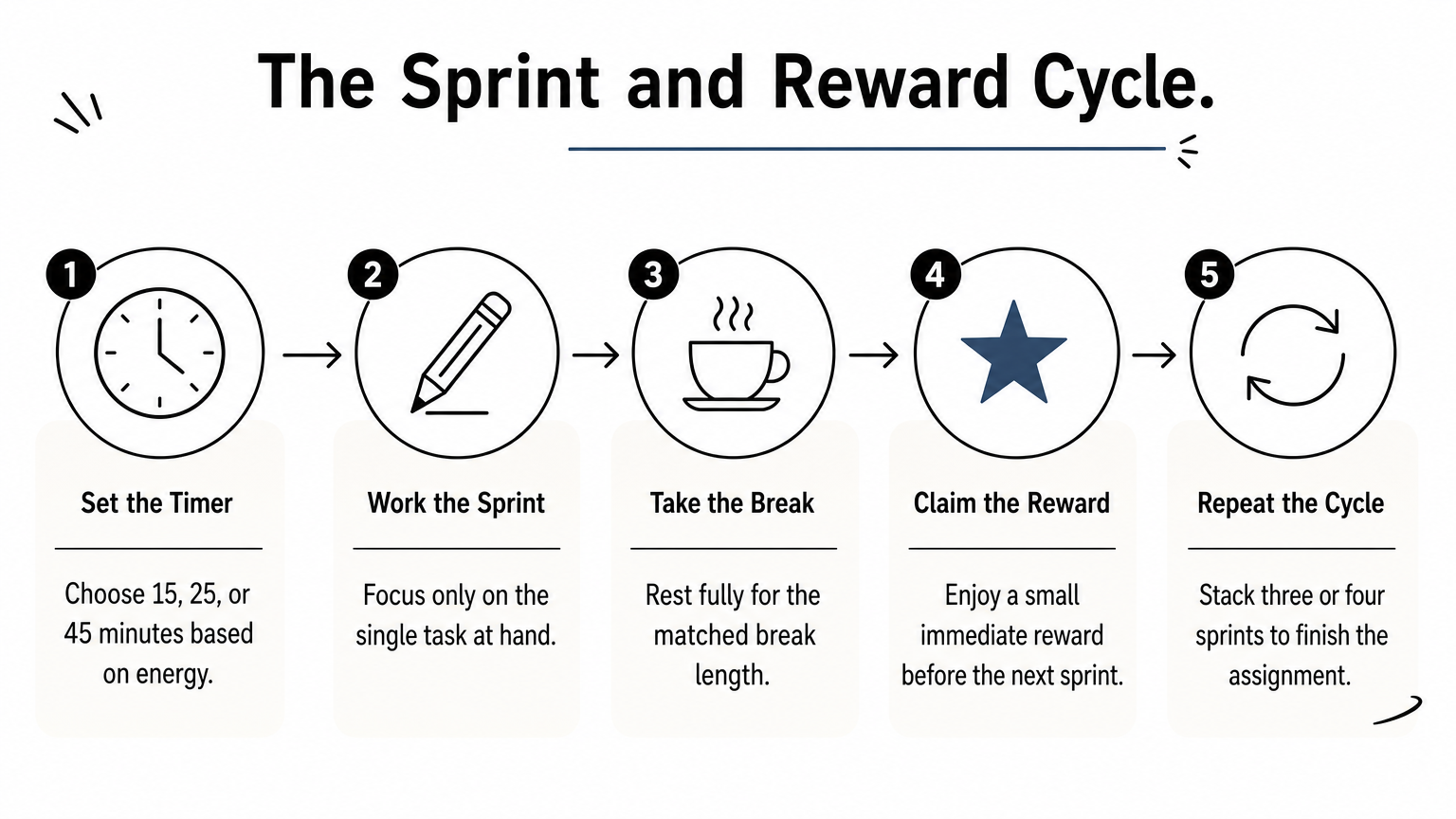
Try the Pomodoro pattern first
The classic version of this, often called the Pomodoro Technique, splits work into 25-minute blocks with 5-minute breaks. If 25 minutes still feels like too much, shrink the sprint to 15 and build up from there.
| Sprint length | Break length | Best for |
|---|---|---|
| 15 min | 3 min | Days when motivation is very low |
| 25 min | 5 min | Standard homework session |
| 45 min | 10 min | Deep focus work like essays or coding |
A 25-minute sprint feels survivable in a way an open-ended homework session never does.
Set a real timer, not your phone's clock app (that's a distraction risk on its own), and treat the break as non-negotiable. Skipping breaks to "push through" usually backfires by the third sprint, when your attention quietly checks out even though you're still sitting there.
Make the reward actually feel earned
Tying a genuine reward to each completed sprint keeps your brain motivated to hit the next one. Keep the reward small and immediate, a snack, two minutes of scrolling, a short walk, rather than something distant like "I'll relax this weekend." Distant rewards don't register the same way to a brain that's trying to avoid discomfort right now.
Stacking three or four sprints back to back, with breaks in between, gets most students through an entire assignment that felt impossible an hour earlier. Anyone still muttering "i don't wanna do my homework" by sprint two usually just needs a shorter interval or a better break, not more discipline. If you've run several sprints and you're still stuck on the actual content rather than the starting, that's a sign the problem has shifted, and it's time to bring in outside help.
Step 5. Know when to ask for backup
Sometimes the resistance isn't about starting at all, it's about being genuinely lost on the content, and no amount of timed sprints fixes a knowledge gap. If you've run two or three sprints and you're still staring at problem four with zero idea how to approach it, that's not avoidance anymore, that's a skill gap, and it needs a different kind of help than a five-minute trick.
Recognize the signs you've hit a real wall
A few clues separate ordinary procrastination from a genuine block worth outsourcing:
- You've reread the instructions three times and still can't explain what's being asked
- You got through the easy problems but the harder ones use a concept you never actually learned
- The deadline is inside 24 hours and you're nowhere near finished
- You've tried every trick in this guide and you're still stuck on the same page
If you've tried the tricks and you're still stuck, the problem isn't motivation anymore, it's the material itself.
Use expert help to get unstuck, not to skip the work
This is exactly the gap a service like HomeworkHelper.us is built for. You submit the assignment and your deadline, get matched with a vetted expert in that specific subject, whether it's accounting, computer science, or economics, and get step-by-step explanations that show you the reasoning, not just a final answer to copy. That distinction matters for two reasons: it actually teaches you the concept your professor expects you to know, and it keeps you inside your school's academic integrity policy instead of outside it.
Check the quote before you pay so there are no surprises, and pick a turnaround window that matches your real deadline, options usually run anywhere from 24 hours to a full week depending on how much runway you have left. If you're the kind of student who says "i don't want to do my homework" because a single concept keeps derailing an entire assignment, getting that one thing explained clearly often unlocks the rest of the work on your own. Asking for backup here isn't giving up, it's the same move as asking a TA a question during office hours, just available at midnight when the TA isn't.
Turning "I don't wanna" into "I did it"
That wall of resistance you started with tonight isn't a permanent trait, it's a signal you now know how to read. Naming the real block, whether it's confusion, exhaustion, or fear of a bad grade, tells you exactly which fix to reach for instead of guessing. Shrinking the task, clearing your space, and working in sprints handle the starting problem. What they can't fix is a genuine gap in understanding, and that's fine, because that gap has its own solution.
Still saying "i don't wanna do my homework" after trying all five steps usually means the sticking point is the material, not your willpower. That's the moment to stop grinding alone and get a second set of eyes on the actual problem. Submit your assignment and deadline to a vetted expert on HomeworkHelper.us, get the concept explained clearly, and finish the rest of the work yourself, tonight, not next week.