
Science and Technology
6 Ways to Pay Someone to Do My Physics Homework Safely
Compare 6 ways to pay someone to do my physics homework, from $30-$100 tutors to AI solvers, with costs, risks, and what schools allow.

6 Ways to Pay Someone to Do My Physics Homework Safely
You have a problem set due in two days, a lab report half finished, and a mechanics chapter that still makes no sense. So you search for how to pay someone to do my physics homework and hope you find something that is fast, affordable, and not a scam. Plenty of sites will take your money and deliver copied or wrong answers. Safety is the real question.
Here is the short answer. Yes, you can hire a physics tutor or expert online, and it is generally legal. What matters is how you use the work. Prices and turnaround times vary widely, with deadlines from 24 hours to 7 days being typical, and the safest options let you see a quote and check the expert's credentials before you pay. Free tools and AI solvers exist too, but they often fail on multi-step problems.
This list covers six ways to get paid help, from vetted expert platforms like HomeworkHelper.us to tutoring and free alternatives. For each, you will see what it costs, how fast it works, and what to check before you pay, so you can protect your grade and your money.
1. Hire a vetted physics expert on HomeworkHelper.us
How it works
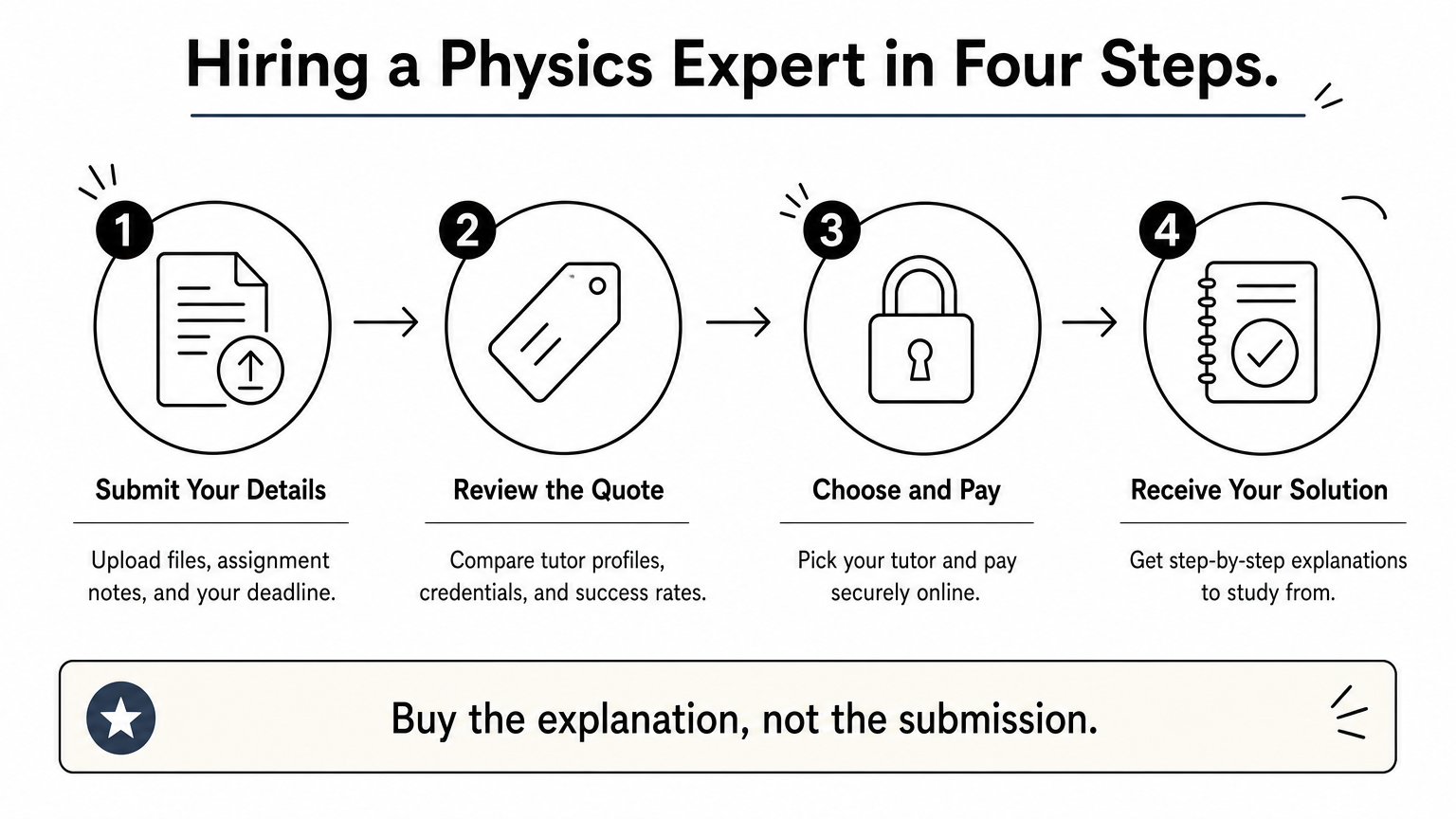
HomeworkHelper.us is a US-based platform with 500+ vetted experts, including PhD-level tutors, across 100+ subjects. If you want to pay someone to do my physics homework without gambling on a stranger, the process is short:
- Submit your assignment details, files, and deadline.
- Review the quote and compare tutor profiles, which show credentials, order history, and success rates.
- Choose a tutor and pay securely.
- Receive a solution with step-by-step explanations.
Who it's best for
This route suits students stuck on calculus-based mechanics, electricity and magnetism, or thermodynamics who are also short on time. Work and other classes make a full evening of problem sets unrealistic, and you want an expert who can show the reasoning.
Skip it if you only need a hint on one equation. A free resource or AI solver covers that for nothing.
Pricing and turnaround
You see the price before you pay, so there are no surprises after the work starts. Deadlines run from 24 hours to 7 days, and new and returning clients can often use codes worth 15-25% off.
| Detail | What to expect |
|---|---|
| Deadlines | 24 hours to 7 days |
| Payment | After you see the quote |
| Discounts | Codes worth 15-25% off |
| Support | Available 24/7 |
Safety and academic integrity
Rated 4.9/5 across review platforms, the service lets you verify a tutor's track record before committing. That transparency matters more than any promise on a landing page.
Pay for the explanation, then make sure you can reproduce it yourself.
Use the finished solution as a worked example. Study each step, redo a similar problem without looking, and follow your professor's policy on outside help. Treating the work as a model answer keeps you on the right side of academic integrity and prepares you for the exam, where no expert is sitting next to you.
2. Use a private physics tutor for step-by-step solutions
How it works

You book a session with a physics tutor, usually through a tutoring marketplace or a campus bulletin board, and solve the problems together in real time. The tutor explains each step while you do the algebra. A good session follows this pattern:
- Send your problem set and syllabus ahead of time.
- Attempt each problem first so the tutor sees where you stall.
- Ask for a written walkthrough afterward to review later.
Who it's best for
Students who want to understand the material get the most from this route. It fits you if exams carry most of your grade and you have a week or more before the deadline.
Pass on it if the work is due tomorrow. Good tutors are often booked solid, and a single session rarely covers a full problem set.
Pricing and turnaround
Rates depend on credentials, and hourly pricing adds up fast on long problem sets. Budget for several sessions per unit, not one.
| Detail | Typical range |
|---|---|
| Rate | $30 to $100 per hour |
| Booking time | 1 to 7 days |
| Deliverable | Live explanation and notes |
Safety and academic integrity
Tutoring is the lowest-risk paid option because you do the writing and the thinking. Most professors encourage it, and many schools offer it through learning centers.
A tutor who explains your homework is safe; a tutor who writes your submission is not.
Check reviews and confirm the tutor's physics background before paying. Keep your own notes from each session, so you can show how you reached your answers if anyone asks.
3. Order from a large homework marketplace
How it works
Large marketplaces work like job boards. You post your assignment, freelancers bid with their own prices, and you pay through the site once you pick one. The catch is that quality varies by freelancer, not by brand name.
- Post the problem set, files, and deadline.
- Compare bids, ratings, and completed orders.
- Message your pick before you pay.
Who it's best for
Students with tight budgets and time to vet bidders get the most from this route. It fits algebra-based intro physics better than upper-level courses.
Avoid it for graded lab reports or calculus-based work, where one wrong sign costs points. A vetted expert with visible credentials is the safer pick there.
Pricing and turnaround
Bids are usually lowest for intro-level work, but cheap bids often mean thin explanations. Turnaround depends on who accepts your job, so confirm the deadline in writing.
| Detail | Typical range |
|---|---|
| Cost per problem | $10 to $40 for intro level |
| Turnaround | A few hours to 7 days |
| Payment | Held by the platform until delivery |
Safety and academic integrity
Risk is higher here because freelancers are rarely credential-checked, and some resell recycled solutions that plagiarism software flags.
A low bid tells you the price, not the quality.
Request a sample step before you commit, keep all chat inside the platform, and never share your school login. Treat the delivered work as a study model, and check your professor's policy first.
4. Choose a Q&A and solutions library with tutor support
How it works
Q&A libraries are subscription sites with a searchable archive of solved textbook problems. You find your problem, read the worked solution, and on many sites ask a tutor a follow-up question when the archive comes up empty.
- Search by textbook, edition, and problem number.
- Compare the worked steps with your own attempt.
- Use tutor chat for problems the archive lacks.
Who it's best for
Students whose assignments come straight from a popular textbook get the most here, because archived answers often match those problems exactly.
Look elsewhere if your professor writes original problems. Archives will not have them, and custom problem sets need a live expert or tutor.
Pricing and turnaround
Access costs far less than hiring a person, since you pay a flat subscription and get instant answers for anything already archived.
| Detail | Typical range |
|---|---|
| Subscription | $10 to $40 per month |
| Archived solutions | Instant |
| Custom tutor questions | Minutes to 24 hours |
Safety and academic integrity
Risk sits mostly in accuracy. Archived solutions can contain errors, and because thousands of students see the same answer, copying one word for word can trigger plagiarism checks.
A shared solution is a study guide, never a submission.
Verify every result by checking units and limiting cases, then rewrite the reasoning in your own words. Cancel the subscription once the unit ends.
5. Try an AI physics solver as a cheaper starting point
How it works
You type a problem or snap a photo, and the tool returns a worked solution in seconds. Many solvers also scan handwritten equations, which saves typing. Use it like this:
- Enter the full problem, including given values and units.
- Read each step instead of copying the final number.
- Ask a follow-up when a step skips the reasoning.
Who it's best for
Students who need a quick hint on single-step problems, like kinematics or basic circuits, get the most value. It also works for checking your own answer before you submit.
Skip it for multi-part problems, free-body diagrams, or lab data analysis. Solvers misread diagrams and drop signs, so they often fail exactly where the points are.
Pricing and turnaround
Most tools offer a free tier with a few solves per day, and paid plans unlock full step-by-step answers. Results arrive instantly, which makes this the fastest option on the list.
| Detail | Typical range |
|---|---|
| Free tier | Limited daily solves |
| Paid plan | $5 to $25 per month |
| Turnaround | Seconds |
Safety and academic integrity
Accuracy is the main risk. AI can state a wrong answer with total confidence, and many schools now treat undisclosed AI use as a violation.
An AI answer is a draft to verify, never a final answer to submit.
Check units, test limiting cases, and read your syllabus before you rely on it. When you pay someone to do your physics homework, you are buying accuracy that a solver cannot promise, so move up to a vetted expert if the tool gets a problem wrong twice.
6. Get free help from office hours and study groups
How it works

Your professor and teaching assistants hold weekly office hours, and many physics departments run free help rooms staffed by graduate students. You bring the problems that stall you and work through them with people who know how the course is graded. Study groups add classmates who have hit the same walls.
- Bring your attempted work, not a blank page.
- Ask about the first step you cannot take.
- Meet with three or four classmates before the due date.
Who it's best for
Students with a few days of lead time get the most here. Try this before you pay someone to do your physics homework, because one hour with a TA often clears up a concept that would cost real money elsewhere.
Skip it if the work is due tomorrow and the help room is closed. Schedules are fixed, and you cannot book a slot at midnight.
Pricing and turnaround
The price is $0, but you pay in scheduling. Expect to wait for the next open session, and arrive early before exams, when lines get long.
| Detail | What to expect |
|---|---|
| Cost | Free |
| Availability | Fixed weekly hours |
| Turnaround | Same day to one week |
Safety and academic integrity
This is the lowest-risk option on the list. Your school sponsors it, and professors expect you to use it.
The safest help is the help your professor already offers.
Rules on group work still differ by course, so check your syllabus and write up every solution in your own words. Sharing ideas is fine. Copying a friend's final answer is not.
Is it legal to pay someone to do your homework?
What the law says
Buying tutoring or a worked solution is legal in most of the United States. No federal law makes it a crime to hire a physics expert, and doing so is about as ordinary as buying a textbook.
Some rules are tighter, though. A growing number of states restrict commercial contract cheating services that sell finished work for graded assignments. Those laws mostly target the sellers, not students. Still, legal does not mean allowed.
What your school says
Schools set the real limits. Turning in someone else's work as your own breaks nearly every academic integrity policy, and penalties range from a zero on the assignment to suspension or expulsion.
Legal to buy, risky to submit: your school's policy decides your grade, not the state.
When you pay someone to do your physics homework, the safe move is to buy the explanation, not the submission. Run this check first:
- Read the syllabus section on outside help and collaboration.
- Ask your professor whether tutoring and worked examples are allowed.
- Treat any delivered solution as a study model, then write your own version.
- Keep your notes and drafts as proof of your process.
Choosing the right option for your physics course
Searching for how to pay someone to do my physics homework usually means you are short on time, not effort. The best choice depends on your deadline, budget, and course. Office hours and AI solvers cover small gaps and long lead times. Tutors and Q&A libraries suit students who want to understand the material or whose problems come from a popular textbook.
Whatever you pick, the rule stays the same. Buy the explanation, not the submission, and check your syllabus before you hand anything in. Verify every answer, then redo a similar problem on your own. Your exam score will show the difference.
When the deadline is close and the problems are hard, a vetted expert is the safest paid route. You see the quote first and compare credentials before paying. If that is where you stand, you can get physics homework help from HomeworkHelper.us and learn from every worked step.