
Blog
Should I Do My Homework Now? How to Decide
Wondering should I do my homework now or rest? Use a 4-question framework covering deadlines, grades, and sleep to decide fast and smart.
Should I Do My Homework Now? How to Decide
It's 11 p.m., you're staring at three unfinished assignments, and you're asking yourself should i do my homework or just go to sleep and deal with it tomorrow. That question isn't lazy, it's practical. Pushing through exhausted work often produces sloppy answers anyway, so the real issue is figuring out which choice actually protects your grade and your health tonight.
The honest answer depends on a few factors: how close the deadline actually is, how much sleep debt you're carrying, and whether the assignment is graded for completion or accuracy. If a due date is still days away and you're running on fumes, rest usually wins. If it's due at 8 a.m. and worth real points, you push through smarter, not harder, by cutting the task down to what matters most.
This article walks through a simple decision framework you can run through in under two minutes, covering deadline pressure, mental fatigue, and when asking for outside help makes more sense than white-knuckling it alone. We'll also cover what to do when the answer is "not tonight," so you don't just abandon the work, you reschedule it responsibly.
Why this decision matters more than it seems
Deciding whether to push through an assignment at 11 p.m. feels small, but it rarely is. One skipped assignment can shift a grade by a full letter, and one all-nighter can wreck your focus for the next three days. Students often treat this as a simple willpower test, but it's really a cost-benefit calculation with real academic and physical consequences on both sides. Understanding what's actually at stake helps you stop guessing and start deciding with your eyes open.
The grade math you're actually skipping
Every assignment carries a weight, and most students never check what that weight actually is before deciding to skip it. A homework set worth 2% of your final grade behaves very differently than a problem set worth 15%, yet both can feel equally urgent at midnight. Before you decide, pull up your syllabus and look at three things:
- Percentage of final grade this assignment represents
- Late penalty policy (some professors dock 10% per day, others accept zero late work)
- Whether it's graded for completion or accuracy
If the assignment is graded for completion and worth 3% of your grade, exhaustion isn't worth the trade. If it's a proctored problem set worth 20%, that changes the math entirely.
Sleep debt doesn't stay in one night
Missing sleep to finish homework doesn't just cost you tonight, it borrows against tomorrow. Research from the CDC shows that adults who consistently sleep fewer than seven hours are more likely to report cognitive difficulty, and college students already run at a sleep deficit most weeks. Notice how the fatigue you feel at 11 p.m. is often worse than the fatigue you'll feel tomorrow with even five extra hours of rest. That's not an excuse to skip everything, but it means the assignment you're dreading might genuinely go faster after sleep than it will right now.
The real question isn't whether you can finish tonight, it's whether tonight is when the work will actually get done well.
Overworked brains make careless mistakes: transposed numbers, skipped instructions, weak thesis statements. If your accuracy is what's graded, a groggy 1 a.m. session can cost you more points than a late submission would.
The snowball effect on tomorrow's workload
Pushing an assignment to tomorrow only works if tomorrow has room for it. Quite often it doesn't, because tomorrow already has its own reading, its own quiz, its own shift at work. Skipping tonight's homework without a plan just relocates the stress, and now you're facing two assignments instead of one. This is where a lot of students get burned: they assume future-them will have more energy and more time, but future-them is usually just as tired and just as busy.
Rescheduling only works when you actually reschedule, meaning you block a specific hour tomorrow and treat it like a hard commitment, not a hope.
Weighing grades against mental health
Grades matter, but so does whether you can function the next day. Chronic sleep loss is linked to increased anxiety and lower academic performance over time, according to the National Institutes of Health, which means the short-term win of finishing tonight can quietly undermine your grades over the semester. Still, mental health isn't a blank check to skip everything either. The goal is balance, not avoidance.
| Scenario | Push through tonight | Rest and finish tomorrow |
|---|---|---|
| Assignment worth 15%+ of grade, due 8 a.m. | Usually the right call | Risky unless you can submit early tomorrow |
| Assignment worth under 5%, graded for completion | Rarely worth the exhaustion | Almost always the smarter choice |
| You've had under 5 hours of sleep two nights running | Accuracy will likely suffer | Rest first, work with a clear head |
| Deadline is flexible or has a grace period | Low urgency | Sleep, then tackle it fresh |
This table isn't a rulebook, it's a starting point. Your actual decision depends on your specific deadline, your specific course policy, and how depleted you genuinely are tonight, which is exactly what the next section walks through step by step.
How to decide if you should do homework now
Running through a decision framework beats staring at your laptop hoping motivation shows up. When you're trying to figure out whether to do homework now or wait, the fastest fix is answering four short questions instead of spiraling on the general dread of the assignment itself. Each question narrows the decision by ruling out the emotional noise and leaving you with facts you can actually act on.
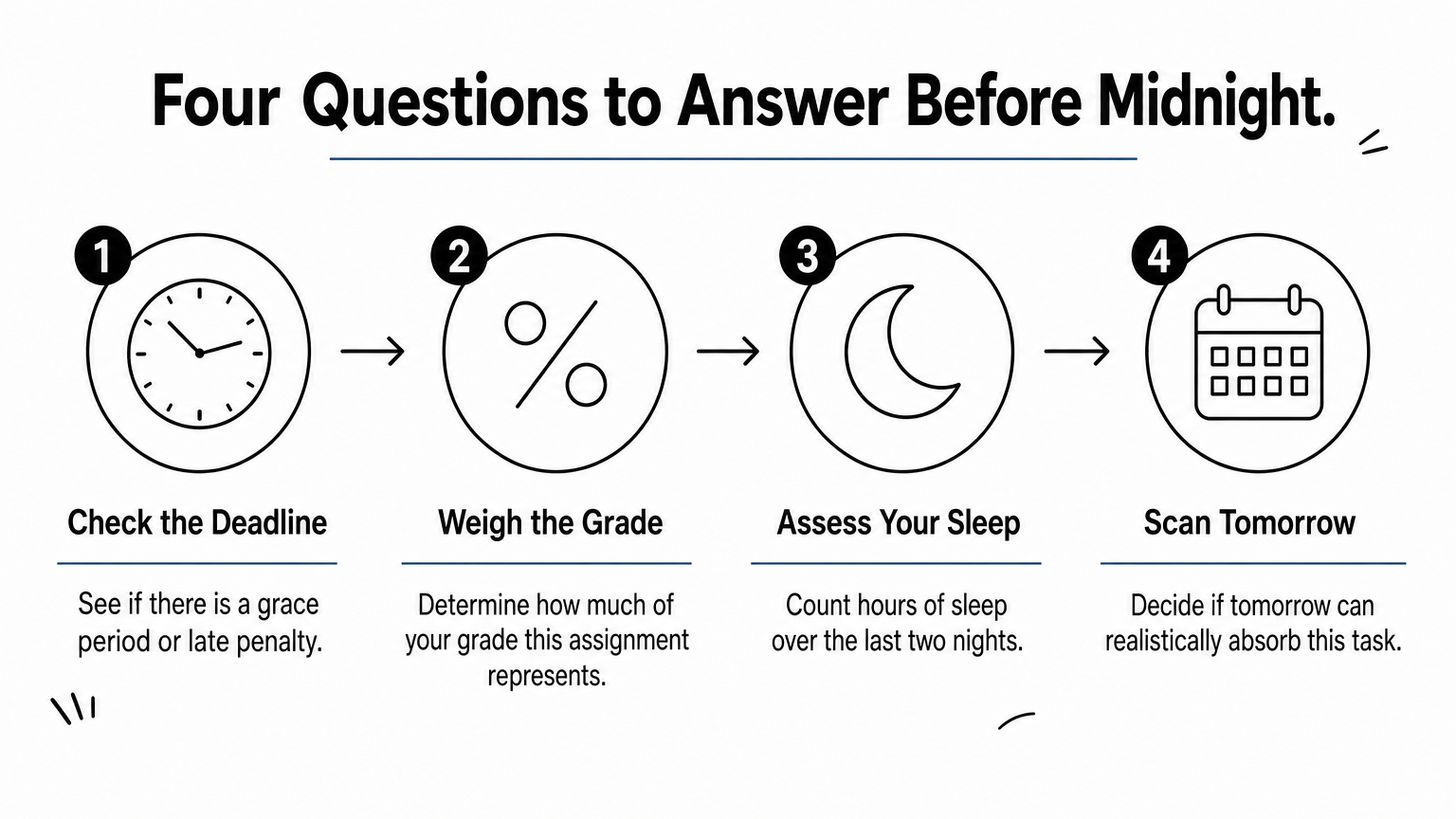
Ask these four questions first
Start with the deadline, then work through the rest in order. Skipping a question usually means you're guessing instead of deciding.
- When is it actually due, and is there a grace period or late penalty?
- How much of your grade does this single assignment represent?
- How many hours of sleep have you had over the last two nights?
- Can tomorrow realistically absorb this task, given your other commitments?
Answer honestly, not hopefully. A lot of students answer question four with wishful thinking, assuming tomorrow will magically be lighter than today.
Score your answers before you commit
Once you have your four answers, weigh them against each other instead of treating any single one as the deciding factor. A tight deadline with a heavy grade weight usually overrides fatigue, but only up to a point, exhaustion past a certain threshold makes even simple math error-prone. Compare your situation to this quick reference:
| Your situation | Likely move |
|---|---|
| Due in under 10 hours, worth 10%+ of grade | Push through, but simplify the task first |
| Due in 24+ hours, worth under 5% | Sleep, then finish with a clear head |
| Under 5 hours of sleep two nights running | Rest takes priority regardless of grade weight |
| Tomorrow's schedule is already packed | Start now, even if only the hardest part |
If two or more answers point toward rest, rest. If two or more point toward urgency, start now and simplify later.
Notice that this isn't about finding a perfect answer, it's about tilting the odds in your favor. Nobody gets this exactly right every time, and that's fine. The goal is to stop the 11 p.m. paralysis where you reread the same paragraph five times without deciding anything.
Gathering this information takes about ninety seconds if you already know your syllabus policies, which is exactly why the earlier grade math matters. Without it, you're deciding blind, and blind decisions at midnight tend to default to whichever option feels easiest in the moment, not the one that actually protects your grade or your health. The next two sections break down what those decision points look like in practice, starting with the clearest signs that tonight is genuinely a start-now situation.
Signs you should start your homework right away
Some nights the decision isn't close at all. When several warning signs stack up together, staring at the ceiling instead of your notebook just delays the inevitable and makes tomorrow harder. Here's what tells you tonight is a start-now situation, not a maybe.
The deadline is inside the danger zone
Questions about whether to do homework now get a lot simpler once the clock is under ten hours. A due date at 8 a.m. with no grace period doesn't leave room for a full night's sleep and a fresh morning session, so waiting just shrinks your options. Check for these red flags before you decide to close the laptop:
- Due before 9 a.m. with no late submission window
- Worth 10% or more of your final grade
- Graded for accuracy, not just completion
- Part of a sequence, where tomorrow's class builds directly on tonight's material
Any one of these on its own is worth noting. Two or more together mean you should open the assignment now, even if you only tackle the hardest part first.
You're tired, but not impaired
Fatigue and impairment aren't the same thing, and mixing them up leads to bad calls in both directions. Feeling foggy after a long day is normal and workable. Feeling like you can't hold a sentence together, reread the same line repeatedly, or forget what you just typed is a different problem entirely. If you're in the tired-but-functional range, starting now while the material is still fresh from class often beats waiting until tomorrow when you've forgotten the context. Recognizing your own baseline here matters more than any external checklist, since your version of "tired" might still be sharp enough to finish clean work.
If you can still explain the assignment out loud in one sentence, you're clear-headed enough to start.
The task is smaller than it feels
Think about the actual scope, not the dread. A worksheet with 12 problems you already understand the method for might take 25 minutes once you stop procrastinating and just open it. Vague anxiety about "homework" often balloons a small task into something that feels unmanageable, and that inflated feeling is usually the biggest thing standing between you and starting. Break the assignment into its real components before deciding it's too much for tonight.
You have momentum from class
Starting right after a lecture or lab session, while the explanation is still fresh in your head, is almost always faster than starting cold two days later. If you just left a class where the professor walked through the exact method you need tonight, that's a strong signal to sit down immediately rather than let the memory fade. Waiting means relearning material you already understood an hour ago, which costs you more time than it saves.
Signs it's okay to rest or sleep first
Sometimes the smartest move is closing the laptop and going to bed, even with an assignment sitting unfinished. Rest isn't avoidance when the situation actually supports it, and ignoring these signals just trades a solvable problem for a worse one tomorrow. Here's what tells you tonight is genuinely a rest-first situation.
The deadline has real breathing room
Before you assume tonight is your only shot, check the actual due time and any grace period attached to it. A lot of students treat "due tomorrow" as "due right now," when the professor actually built in slack you're not using. Look for these signs that the clock isn't as tight as it feels:
- Due after noon tomorrow, giving you a full morning to work
- A grace period or late window built into the syllabus
- No penalty for a few hours late, only for missing the day entirely
- Submission through an online portal you can access before your first class
If two or more of these apply, the deadline pressure you're feeling is mostly imagined.
Your sleep debt is already stacking up
Another clear signal is your own body keeping score over multiple nights, not just tonight. Two or three nights under five hours of sleep in a row does more damage to your focus than one rough night, and pushing through a fourth just deepens a hole you'll need days to climb out of. According to the CDC, adults functioning on chronic short sleep show measurable declines in attention and decision-making, which is exactly the kind of impairment that produces careless errors on homework anyway. Carrying that kind of sleep deficit into an assignment rarely saves you time once you factor in the mistakes you'll need to fix later.
Sleep debt doesn't reset itself. The only fix is actually sleeping, not pushing through one more night.
The assignment rewards accuracy over speed
Consider what's actually being graded before you decide exhaustion is worth it. A completion-based worksheet forgives a groggy attempt, but a problem set graded line by line for correct reasoning does not. Working through calculus derivations or a close-reading essay while your brain is running on fumes usually produces work you'll need to redo anyway, which erases whatever time you thought you saved by skipping sleep.
Tomorrow morning genuinely has open time
Finally, be honest about what your actual schedule looks like tomorrow, not the version you're hoping for. If your first class isn't until 11 a.m. and you don't have a shift or another deadline stacked on top of it, a 6 a.m. wake-up with a clear head often beats a foggy midnight session by a wide margin. That only works, though, if you commit to the wake-up the way you'd commit to any other appointment, not as a vague intention you'll talk yourself out of at 6:15.
What actually happens if you skip it tonight
Skipping homework rarely plays out the way you imagine at midnight. You picture a clean slate tomorrow, but what usually shows up is a late penalty, a stack of makeup work, or a professor who now sees you as someone who cuts corners. Knowing exactly what's on the other side of "I'll do it tomorrow" makes the decision less scary and more informed.
The late penalty is rarely as forgiving as you think
Check your syllabus before you assume the penalty is mild, because most professors dock more than students expect. A common structure looks like this:
| Late window | Typical penalty |
|---|---|
| Under 24 hours late | 10% deduction |
| 24 to 48 hours late | 20 to 25% deduction |
| Over 48 hours late | Zero credit, no exceptions |
That first-day penalty often costs you more than the sleep you're trying to protect was worth. Run the math on your specific course before deciding the trade is fine.
Tomorrow inherits today's problem, plus interest
Most skipped assignments don't disappear, they just move. Tomorrow you're now doing today's homework on top of whatever was already due tomorrow, and that stacking is where students actually fall behind for the rest of the semester. One skipped night rarely sinks a grade by itself, but the pattern of skipping without a plan is what does the damage. If you skip tonight, you need a specific time block tomorrow, not a vague hope that you'll "get to it."
Skipping homework doesn't erase the work, it just adds a deadline penalty on top of it.
Professors notice patterns, not single nights
One late assignment is rarely a big deal to an instructor who sees hundreds of students a semester. What they do notice is a pattern: three late submissions in one class, or a student whose quiz scores start slipping right after skipped homework sets. Those quiz scores usually slip because the homework was practice for the test, not busywork. Skipping it once doesn't just cost you the assignment grade, it costs you the rehearsal you needed for whatever comes next.
Your own memory works against you too
Questions like should i do my homework tonight often ignore how fast forgetting happens. Material from a lecture fades fast, and a 24-hour gap between the lesson and the practice problems means you're relearning concepts instead of just applying them. That relearning tax is real: what would've taken 20 minutes right after class can take 40 minutes two days later, because you're rebuilding context you already had for free.
None of this means you should never skip a night. It means skipping should be a decision, not a default, and it should come with a plan for exactly when and how you'll catch up.
How to get homework done faster once you start
Once you've decided tonight is a start-now situation, speed matters as much as sleep did five minutes ago. Momentum beats motivation here: the goal isn't to feel ready, it's to get moving before your brain talks you out of it again. Most students lose more time deciding to start than they'd spend actually finishing the first problem, so treat the next few minutes as pure execution, not deliberation.
Cut the assignment down to its real size
Breaking the task apart kills the dread that makes it feel bigger than it is. Instead of staring at "finish the problem set," split it into pieces you can knock out one at a time:
- List every question or section as a separate line item
- Mark which ones you already know how to solve
- Flag the two or three that actually need real thought
- Do the easy ones first to build speed and confidence
Once it's broken down, most assignments turn out to be 70% familiar work and 30% genuine problem-solving. That ratio changes how urgent the whole thing feels.
Work in short, timed sprints
Setting a timer for 25 minutes and committing to work without checking your phone gets more done than an open-ended "I'll work until it's finished" session. Tired brains lose focus fast, and a defined sprint gives you a finish line close enough to actually sprint toward. When the timer ends, take five minutes, then start another round if you need it.

A 25-minute sprint with your phone in another room beats two hours of half-focused work with it next to you.
Stacking two or three sprints back to back usually clears more material than one long unfocused stretch, especially past 11 p.m. when your attention span shrinks fast.
Remove friction before you touch the assignment
Every extra step between you and starting is a chance to stall again. Close the tabs that aren't related to the assignment, put your phone somewhere you'd have to physically get up to reach, and have your notes or textbook already open before you sit down. Small friction adds up at midnight in a way it doesn't at 2 p.m., so treat setup as part of the task, not a delay before it.
Know when a tool can save you the grind
Working faster doesn't mean working blind. If you're stuck on a specific problem type, whether that's a math equation, a coding error, or a concept you can't quite untangle, a homework solver tool can walk you through the method step by step instead of leaving you stuck for twenty minutes on one question. Used this way, it's a shortcut through confusion, not a shortcut around learning, which keeps you moving without sacrificing the point of doing the work in the first place.
When to ask for help instead of stalling
Stalling and struggling look identical from the outside, but they cost you differently. If you've been staring at the same problem for twenty minutes with no new ideas, that's not persistence, that's a stall, and stalls don't resolve themselves just because you keep re-reading the instructions. Recognizing the difference between working through a hard problem and spinning your wheels on one is what separates students who finish by midnight from students who're still stuck at 2 a.m. asking should i do my homework or just give up for the night.
The two-attempt rule
Give yourself two real attempts at a stuck problem before you decide it needs outside input. Try the method your notes suggest, then try one alternate approach if the first doesn't work. If both fail, you're not missing effort, you're missing a piece of information you don't currently have, and no amount of extra time alone in your room is going to hand you that piece.
- First attempt fails: reread the relevant example problem or lecture slide
- Second attempt fails: you're missing a concept, not just making a mistake
- Twenty minutes pass with no progress: get outside input now, not after a third try
If two honest attempts haven't worked, the fix isn't more time, it's more information.
Signs you're stalling instead of struggling
Watch for these patterns, because they show up before you consciously notice you've stopped making progress: rereading the same paragraph of instructions three or four times, opening a new tab "just to check something" and losing ten minutes, or feeling your frustration rise without any new understanding to show for it. Stalling often masquerades as diligence, since you're technically still sitting at your desk, but sitting there without forward motion isn't the same as working.
Where to actually get help
Quiet the instinct to just push through alone when a resource exists that solves the exact problem in front of you. A professor's office hours, a classmate who already finished the reading, or a tutor who specializes in your subject can turn a twenty-minute stall into a five-minute fix. Choosing help isn't the same as giving up on the assignment; it's recognizing that some knowledge gaps close faster with a second perspective than with more solo effort at midnight.
Help that builds understanding, not shortcuts
Asking for help works best when it teaches you the method, not just the answer. A tutor who walks through the reasoning behind a solution leaves you able to solve the next similar problem yourself, which is exactly what separates ethical academic support from copying. That distinction matters for your grade tonight and for every test built on the same material later in the semester.
Trusting your own judgment tonight
You don't need a perfect system to answer should i do my homework tonight, you need four honest answers about deadline, grade weight, sleep, and tomorrow's schedule. Run through them, weigh what they tell you, and commit to the call instead of relitigating it at 1 a.m. Some nights the math says push through and simplify. Other nights it says sleep and reschedule with a real plan, not a vague hope.
Whatever you decide, don't let a stuck problem turn into an all-nighter over one concept you're missing. That's a knowledge gap, not a willpower failure, and it closes faster with the right input than with more solo hours staring at the same page. When you hit that wall tonight, get expert homework help instead of grinding through confusion alone, and get back to bed sooner.