Homework Help
Do My Accounting Homework: How to Get Expert Help Fast
Stuck on a "do my homework accounting" search? See why free tools fail, how to spot legit tutors, and get matched fast on HomeworkHelper.us.
Choose your tutor before you pay.
A Little Support Goes a Long Way
Let’s Figure
It Out.

Your Assignment. Your Choice.
- Set your deadline and budget
- Compare tutor bids
- Chat and share files in your dashboard
Do My Accounting Homework: How to Get Expert Help Fast
You've got a trial balance that won't balance, a deadline in six hours, and a professor who explains journal entries like everyone already knows what a debit is. Typing do my homework accounting into Google at 1 a.m. isn't laziness, it's triage. Accounting punishes small mistakes early, and once you fall behind on one chapter, the next one gets harder to follow.
Here's the direct answer: yes, you can pay a qualified tutor to do my accounting homework for me, and you can also find free tools that handle basic problems. The right choice depends on your deadline, the complexity of the assignment, and whether you actually need to understand the material for an exam later.
This article breaks down your real options, from free calculators and AI solvers to vetted, credentialed experts who explain their work instead of just handing you an answer. We'll cover what separates a legitimate service from a scam, what it should cost, and how to get help fast without risking an academic integrity violation.
Why students turn to accounting homework help
Accounting shows up on more homework-help searches than almost any other business subject, and the reasons are consistent across every campus survey and tutoring platform we've reviewed. Students search do my homework accounting because the course structure itself sets them up to fall behind: each chapter builds directly on the last, class sizes are large, and office hours rarely cover more than a handful of students before time runs out. Add a part-time job or a five-course course load, and even strong students end up stuck on a single problem set at midnight.
The double-entry problem: one mistake cascades
Unlike an essay, where a weak paragraph stays contained, accounting errors travel. Miss one adjusting entry in month one and your trial balance won't tie out in month three. Post a debit where a credit belongs and every downstream statement, the income statement, the balance sheet, the cash flow statement, inherits the mistake. Students often don't realize they're wrong until the final total refuses to balance, and by then they've spent hours compounding the original error instead of fixing it.

One wrong debit early in a problem set can quietly wreck every number that follows it.
This is why so many students look for someone to check their work line by line rather than just hand them a final answer. A tutor who catches the error at entry four saves you from redoing entries five through twenty.
Time pressure from overlapping coursework
Deadlines rarely arrive one at a time. A typical intermediate accounting student is juggling a tax return project, a cost accounting case study, and weekly homework sets, all due within the same 72-hour window. When three deadlines collide, the choice isn't between doing the work yourself or not, it's between submitting something late, submitting something rushed, or getting help fast enough to submit something correct. Students who work part-time jobs or care for family members feel this pressure hardest, since they have fewer flexible hours to absorb an unexpected accounting crunch.
Concepts that don't click from lectures alone
Despite what many syllabi assume, accounting concepts often need a second explanation before they stick. Depreciation methods, bond amortization schedules, consolidated financial statements, and variance analysis are the topics tutors report seeing most often, because a 50-minute lecture rarely leaves room for worked examples at the pace a struggling student needs. Below are the topics that generate the most homework-help requests, based on patterns we see across student submissions:
- Adjusting entries and the accrual basis of accounting
- Depreciation methods (straight-line, units-of-production, double-declining balance)
- Bank reconciliations and internal controls
- Job order and process costing
- Bond issuance, premiums, and discounts
- Consolidated financial statements and intercompany eliminations
- Standard costing and variance analysis
- Statement of cash flows (indirect method especially)
Every one of these topics has a right answer, but getting there requires a specific sequence of steps. Skip one step and the whole problem falls apart, which explains why generic search results and quick forum answers rarely solve the actual assignment.
When free tools aren't built for your assignment
Searching do my accounting homework for me free makes sense as a first move, and plenty of calculators handle a simple present value or straight-line depreciation problem correctly. But once an assignment asks for a full set of consolidated statements, a multi-step process costing report, or a case study with written justification, free tools stop being reliable. They're built for isolated computations, not the layered, narrative-style problems that make up most upper-level accounting courses. That gap is exactly why students eventually search for do my accounting homework paired with a real tutor's name rather than another calculator.
From Stuck to Started
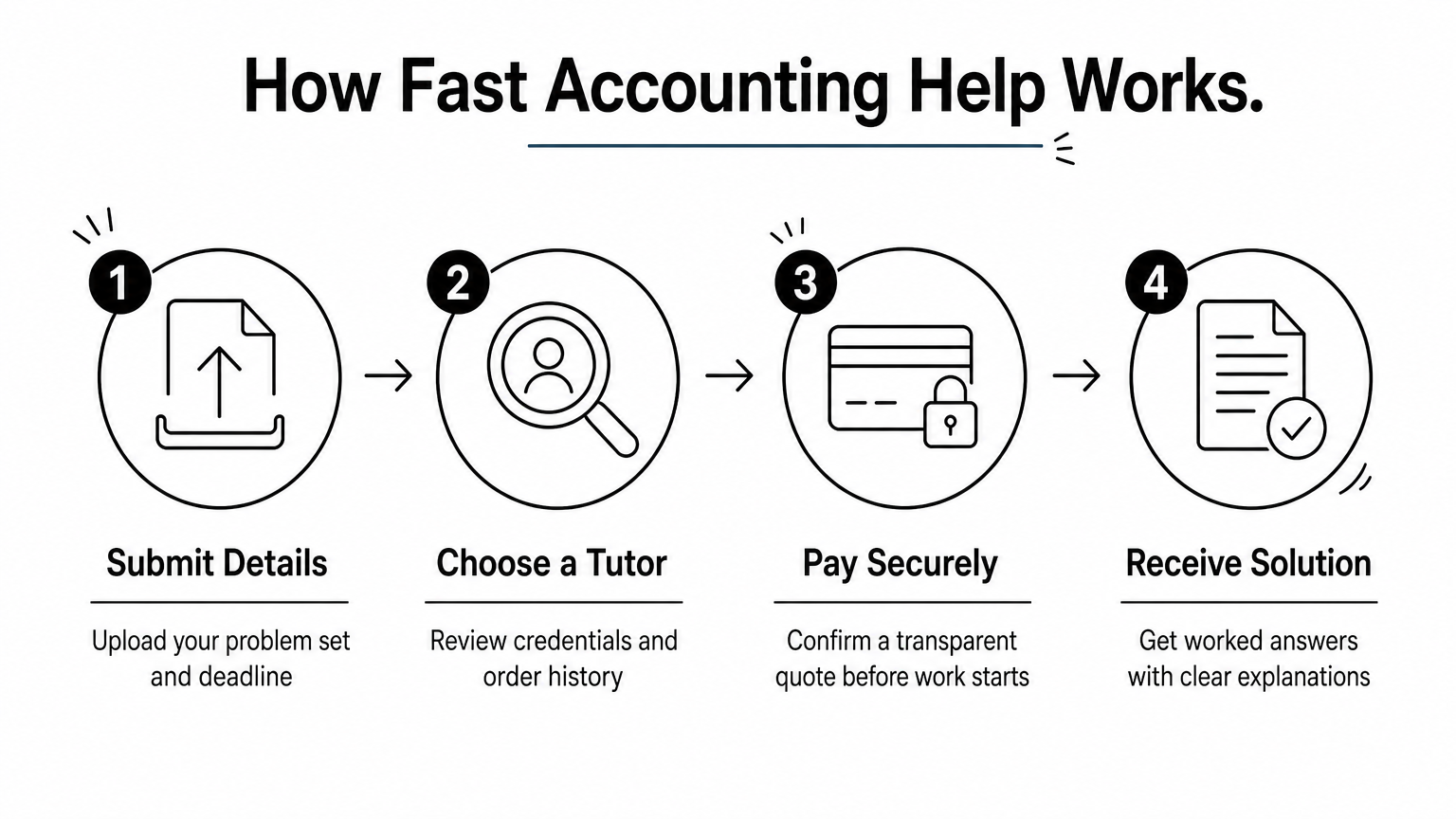
Help in Three Simple Steps
Share Your Assignment
Add your instructions, files, deadline, and budget.
Choose Your Tutor
Compare bids and chat with tutors before choosing.
Work Through It Together
Keep your conversation, updates, and files in one place.
You Don’t Have to Figure It Out Alone